How AI Is Changing Business—and Where to Start
A practical guide for business owners: useful examples from sales, management, and operations, sensible boundaries, and a four-week plan to get started.


A customer is waiting for a quotation. Your sales manager is chasing an update from the warehouse. Finance has sent a report, but you still need someone to explain why sales are up and cash is tight.
By the time you get the answers, half the day has gone.
For many business owners, this is where artificial intelligence becomes interesting. It can shorten the distance between a question and a useful answer, and take some of the repetitive preparation out of everyday work.
As a software engineer and the founder of Gluon ERP, I look at AI through a practical lens: does it help someone do useful work better? A clever demonstration is one thing. A quotation sent on time, a mistake caught before dispatch, or a clearer view of the business is something else.
That is where I believe owners should begin.
Start with the work that keeps getting in the way
Most businesses do not have a shortage of information. They have information scattered across emails, spreadsheets, software, and people’s memories.
Someone reads a long customer conversation and writes a summary. Someone else turns meeting notes into tasks. A manager searches previous proposals to prepare a new one. These jobs are necessary, but they often involve repeating work the business has already done.
AI can help prepare that first version. Given the right material, it can draft a proposal, organise a discussion, or suggest a response. A person then checks the details and makes the decision.
There is evidence for this kind of benefit. A study published in The Quarterly Journal of Economics in 2025 examined 5,172 customer-support agents and found that AI assistance increased issues resolved per hour by 15% on average. Results varied across workers. That is evidence from one setting, not a forecast for your company. Your own results need measuring.
Look for the task your team repeats every day, then ask what a better version of that task would look like.
Three places a business owner can see the difference
1. Sales: less preparation, more attention to the customer
Imagine a trading company receiving an enquiry with several products, quantities, and delivery requirements. A salesperson has to understand the request, check missing details, prepare a quotation, and arrange a follow-up.
An AI assistant connected to approved information could extract the requirements, flag unanswered questions, and prepare the quotation text. The salesperson would still verify stock, pricing, discounts, and delivery commitments before anything goes to the customer.
The benefit is more time for the part that needs a person: understanding why the customer is buying, what matters to them, and whether the offer is right. Track quotation turnaround time and correction rates. Faster work is useful only if it stays accurate.
2. Management: better questions about the numbers
A report may tell you that revenue increased. As an owner, you probably want to know whether the growth came from healthy repeat business, a one-off order, or heavier discounting.
With access to reliable records, an AI interface can help you explore questions such as: “Which customers bought less this quarter?” or “Which products grew in sales but fell in gross margin?”
The underlying calculations should come from your accounting or reporting system. AI can help explain those results and suggest what to examine next. Ask it to show the period, filters, and source records. If a conclusion matters, you should be able to trace it.
3. Operations: spotting exceptions before they become urgent
Consider a manufacturer reviewing materials for next week’s production. Stock on hand alone is not enough. Some quantities may already be committed, a purchase order may be late, and demand may have changed.
A properly connected system can bring these records together. AI can help turn the exceptions into a readable briefing: which materials need attention, which orders may be affected, and which questions purchasing should resolve.
That capability depends on integration, sound planning logic, and accurate records. A general chatbot with no access to your business cannot know what is in your warehouse. Even a connected assistant should not promise a delivery date or place an order without the authority and checks you have defined.
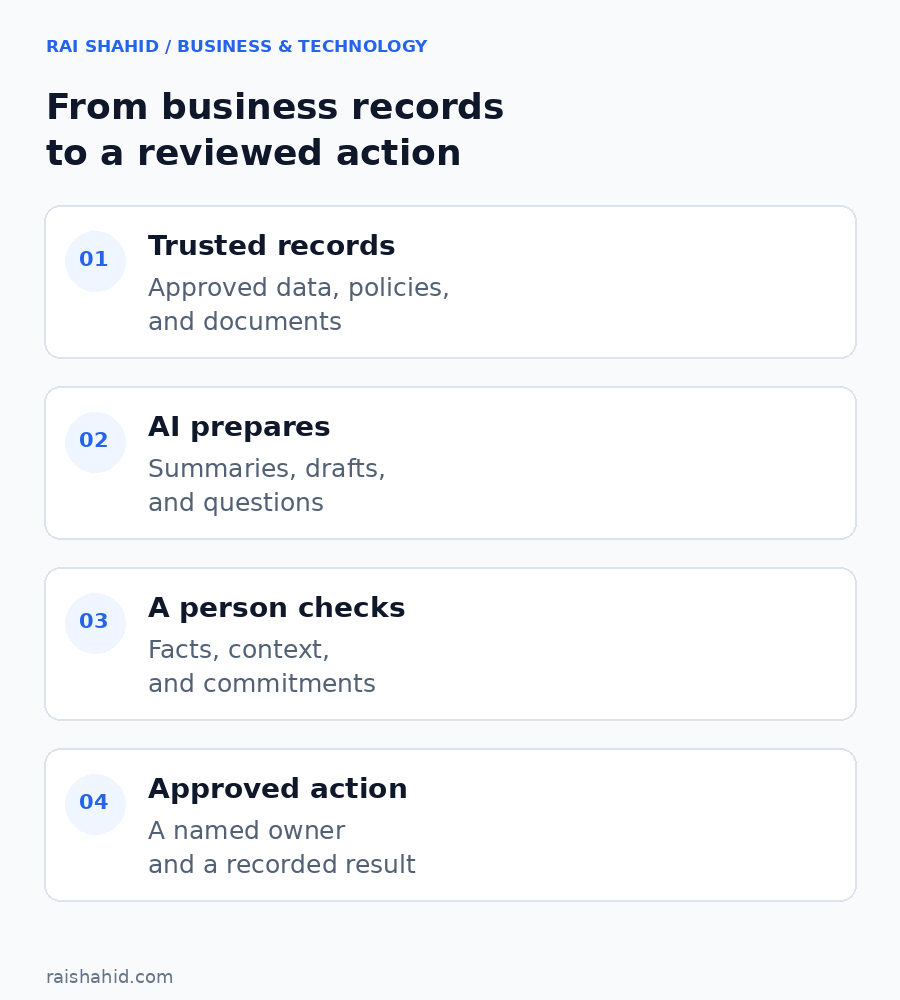
Start with assistance. Give a system permission to act only when the controls match the consequences.
Your business data still has to make sense
One product entered under three names will cause confusion whether a person or an AI system is reading the report. Missing purchase costs will still distort margins. An outdated customer balance will still lead to an awkward conversation.
Before connecting AI to important processes, agree on where the correct information lives, who maintains it, and who may see it. A salesperson should not gain access to payroll simply because they can ask a question in plain English.
This makes the ordinary work of running good systems more valuable: consistent product names, clear approvals, timely entries, and reliable records. AI depends on that foundation.
Keep responsibility clear
AI can produce a confident answer that is wrong. NIST’s guidance on generative AI identifies this risk, alongside concerns such as data privacy. In a business, the consequences may be an incorrect quotation, an unsuitable recommendation, or information shared with the wrong person.
I would begin with a simple boundary: let AI prepare work that a capable person can check. Keep payments, contractual commitments, sensitive employee decisions, and changes to live financial records behind explicit approval.
Use approved tools, check how they handle your information, and share only the data needed for the task. Your team should know what they can use, what they must verify, and when to ask for help. Make reporting mistakes normal; hidden mistakes are harder to fix.
A first month that can teach you something
You do not need to introduce AI across the whole company. Choose one frequent task with a clear owner and a result you can inspect. Drafting follow-up emails from approved meeting notes is a more manageable starting point than handing over purchasing decisions.
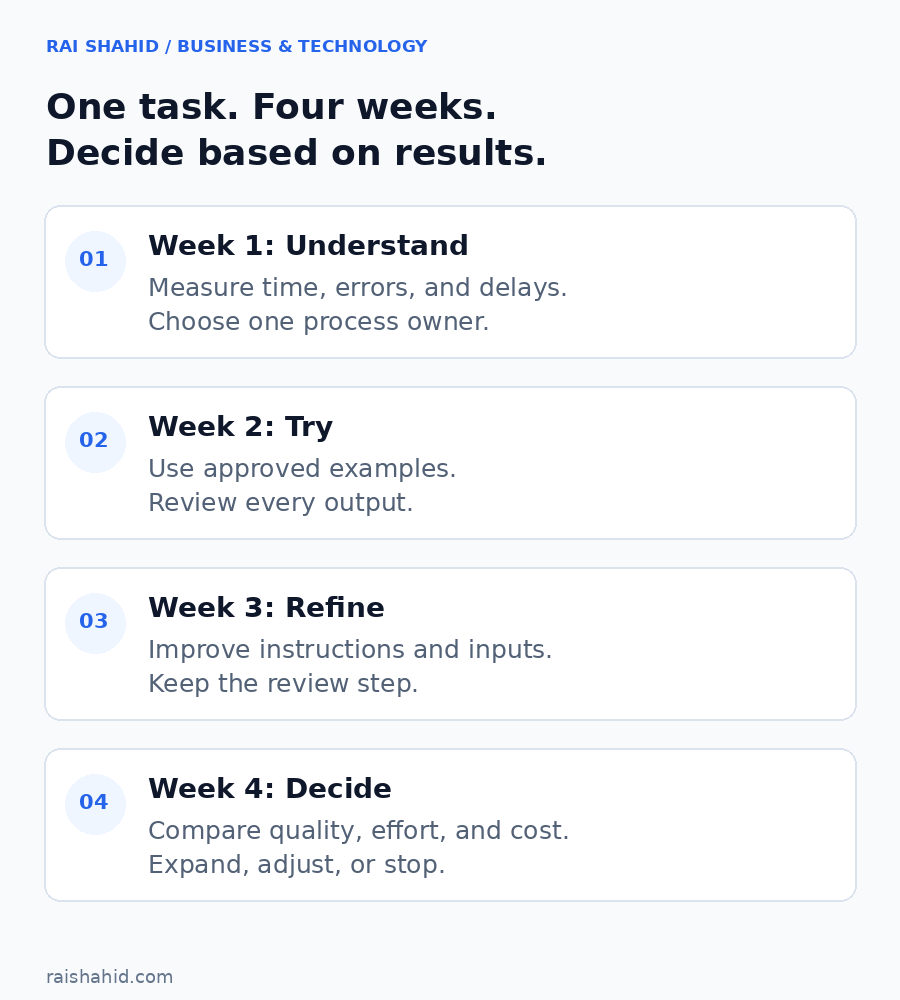
Measure the whole task, including checking and fixing the output. Saving ten minutes on a draft means little if correcting it takes fifteen.
A small scorecard for your trial
| What to measure | The question to answer |
|---|---|
| Total time | Is the complete task faster, including review? |
| Quality | Are errors and rework going down? |
| Business result | Are customers answered sooner or delays reduced? |
| Cost | Does the benefit justify tools, setup, training, and supervision? |
For example, saving six minutes on twenty tasks each working day adds up to forty-four hours over a twenty-two-day month. That is an illustration, not a promised result. It becomes valuable when you use that time well: following up customers, clearing a backlog, or improving service. Freed capacity does not automatically become cash savings.
Give your team a useful way to begin
“Use AI” is too vague an instruction. Give someone a specific task, approved material, and a standard to meet. For a sales follow-up, the instruction could look like this:
Using only these approved meeting notes, draft a short customer follow-up. Summarise the agreed requirements, list unanswered questions, and include the next step and its owner. Do not invent prices, delivery dates, or commitments. Mark missing information clearly. Prepare a draft for review; do not send it.
Then ask the employee to check what was missed, what was invented, and what took longer than expected. Their knowledge of the job is part of making the system useful.
The owner’s role still matters
AI makes it easier to produce more: more reports, more messages, more proposals. But a business does not improve just because it produces more material.
Someone still has to decide which customer needs attention, which promise the company can honour, and which problem deserves investment.
My advice is to start with one frustrating piece of work. Give your team a sensible way to improve it, keep responsibility clear, and measure what happens. A modest improvement that survives everyday use is a better foundation than an impressive demonstration nobody uses again.
The opportunity is to build a business with more time to think, better information to work with, and people who can give customers more of their attention.
About Rai Shahid
Rai Shahid is a technology entrepreneur, software engineer, and Founder & CEO of Gluon ERP, based in Lahore, Pakistan. His work focuses on business software for manufacturing and trading companies.
Sources & further reading
- Erik Brynjolfsson, Danielle Li, and Lindsey Raymond. Generative AI at Work. The Quarterly Journal of Economics, 140(2), 2025. The reported productivity result concerns the customer-support setting studied.
- National Institute of Standards and Technology. Artificial Intelligence Risk Management Framework: Generative Artificial Intelligence Profile. July 2024.
Business scenarios and the four-week trial are illustrative recommendations, not claims of measured results at Gluon or its customers. Sources checked 21 October 2026.