Your Warehouse Is Full—but Customers Still Hear “Out of Stock”
A practical inventory guide for Pakistani business owners and CFOs: usable stock, ageing, reorder levels, and a worked PKR purchasing example.


It is a familiar kind of Monday. The warehouse is crowded, purchasing has another supplier quotation to approve, and the stock report shows millions of rupees on hand.
Then a customer asks for a regular item. Sales checks with the warehouse and comes back with the answer nobody wants to give: out of stock.
Both reports can be correct. A business can own plenty of inventory and still be unable to supply what its customers need.
My starting point would be to stop asking whether stock is high or low in total. I would ask: which items are available, where are they, and will they last until usable replenishment arrives?
A full warehouse is not the same as a useful warehouse
Inventory serves different purposes. Some goods support regular sales. Others belong to a specific order, await inspection, or have barely moved for months. Adding their values together hides these differences.
A Lahore trader might have several sizes of the same fitting, yet lack the one a contractor needs. A paint manufacturer may have enough resin for production but no suitable tins for the required pack size. More spending on the wrong item will not solve either problem.
Start with three quantities for each item and location:
- Physical stock: what is actually present.
- Usable stock: physical stock less damaged, blocked, expired, or otherwise unsuitable quantities.
- Free stock: usable stock less quantities already committed to customers or production.
Keep incoming purchases separate. A purchase order is a promise of future supply, not goods available for dispatch today. Transfers between warehouses also need realistic arrival dates.
Read ageing alongside demand
An ageing report is useful, but first agree what it measures. Age since receipt and days since last sale answer different questions. A recently received batch can belong to a product that has been losing demand for months.
I would review remaining receipt quantities by age, recent consumption, open commitments, and remaining shelf life where relevant. Suggested buckets such as 0–30, 31–60, 61–90, and over 90 days are a starting point for discussion, not a universal definition of dead stock.
A critical spare may sit unused because the business needs protection against a breakdown. A seasonal item may have a credible future market. An obsolete colour or incompatible component needs a different decision. Each explanation should have evidence and a review date.
For example, a fictional PKR 8 million stock balance might contain PKR 3 million of slow-moving goods. That is a reason to investigate, not an assumption that PKR 3 million can immediately become cash. Selling, returning, or consuming those goods may take time and involve costs.
Illustrative worked example: 300 packs, but only 200 free
Consider a fictional trader selling a standard pack at a purchase cost of PKR 2,500 per pack. These are teaching figures, not a customer case or a market benchmark.
| Stock position today | Packs |
|---|---|
| Physically present | 300 |
| On quality hold | (20) |
| Usable stock | 280 |
| Already committed for immediate dispatch | (80) |
| Free stock after those commitments | 200 |
The 80 committed packs are reserved now. The demand forecast below covers additional demand, so we do not count those commitments twice.
Assume additional demand averages 20 packs per calendar day, replenishment takes 15 calendar days from order approval to usable receipt, and management chooses a provisional safety buffer of 100 packs. All three assumptions need checking against actual history.
For a continuously reviewed item, a simple planning calculation is:
Reorder point = expected demand during replenishment lead time + safety stock.
Here, that is 20 × 15 + 100 = 400 packs. The reorder point signals when to act; it is not the purchase quantity. Oracle NetSuite explains this distinction and the reorder-point calculation.
Suppose an existing, confirmed purchase of 100 packs will become usable on day 5. A simplified inventory position is then 280 usable on hand + 100 on order − 80 outstanding commitments = 300 packs. It is below the 400-pack trigger.
Under a separately agreed illustrative order-up-to target of 800 packs, the suggested purchase is 800 − 300 = 500 packs, costing PKR 1.25 million before any additional freight or applicable taxes. The target is a chosen policy for this example, not a recommended standard.
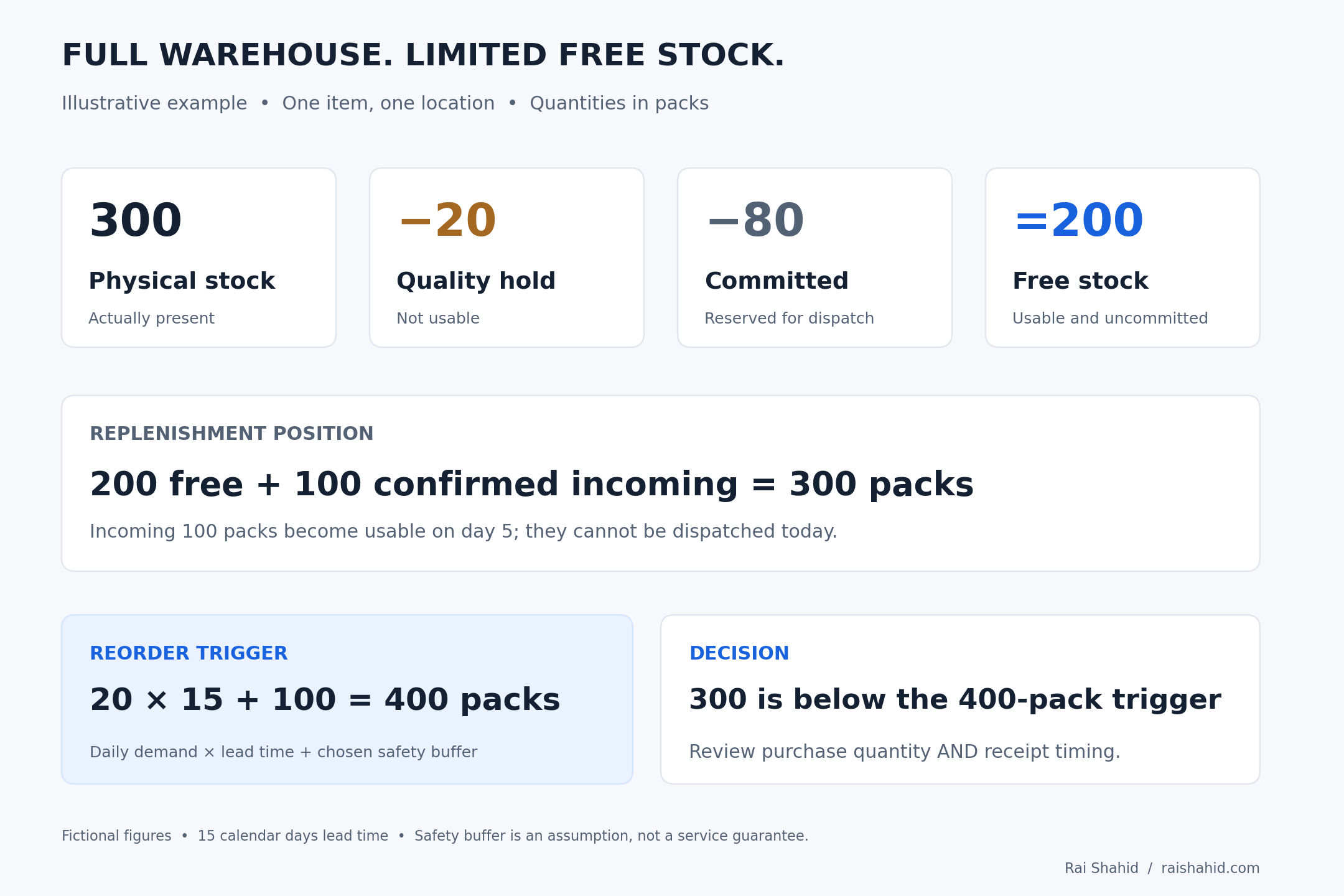
The timing check matters as much as the formula. Starting with 200 free packs, adding 100 on day 5, and consuming 20 daily leaves zero immediately before a new day-15 receipt. The safety buffer will already have been breached. If that new receipt slips to day 20, the projected shortfall is 100 packs, assuming demand continues.
So placing the order now does not remove the immediate risk. Purchasing must confirm dates, assess an earlier delivery or a suitable transfer, and tell sales which promises are supportable. Do not add another purchase simply because an overdue order has disappeared from view.
Set reorder rules around the way the business actually works
Measure lead time to the point the goods can be used. Supplier preparation, transport, receiving, and inspection can all matter. For an imported material, include the relevant shipment and clearance stages using your own records rather than a supplier's best-case estimate.
Demand and delivery variability also matter. NC State University's safety-stock tutorial explains why a buffer is needed when either varies. The 100-pack buffer above is a management assumption; it does not establish any particular service probability.
If purchases are reviewed only once a week, account for the additional wait until the next review. A rule designed for continuous monitoring cannot be copied unchanged into a weekly routine.
For manufacturing, connect materials to the production plan and bill of materials. Avoid counting both the finished-product forecast and its material requirements as separate demand for the same component. Also check batch sizes, yields, and packaging requirements. A reorder alert alone cannot schedule a factory.
Give slow stock an action, not another report
For each important slow-moving line, choose an action: use it against a genuine production requirement, transfer it to a location with demand, negotiate a supplier return, offer an appropriate commercial sale, or assess disposal. Assign an owner and date.
Do not quietly replace a specified material just to consume old stock. Technical suitability, quality approval, and customer requirements still apply. Finance should separately review any accounting adjustment with the appropriate adviser; an operational ageing flag does not by itself determine a write-down.
Before approving a bulk discount, calculate the extra cash committed and the likely holding period. In our example, a minimum order of 1,000 packs would commit PKR 2.5 million before extras, twice the suggested 500-pack purchase cost. That difference deserves an explicit decision about demand, alternatives, and funding.
BDC's inventory-management guidance recommends balancing service needs and carrying costs, with item-specific replenishment settings. A discount should be assessed within that wider decision.
Let the records support one weekly conversation
As a software engineer, I would want the system to connect item codes, units, locations, reservations, purchase dates, and production requirements. Duplicate codes or confusion between pieces, cartons, kilograms, and litres can defeat an otherwise sensible policy.
Use targeted physical counts to investigate discrepancies. Correct the receiving, issuing, or transfer process behind a difference; repeatedly adjusting the balance leaves the cause in place.
Then bring sales, purchasing, operations, and finance together around a short exception list:
| Exception | Decision to make |
|---|---|
| Critical item will run short before its next receipt | Confirm supply and revise delivery promises |
| Slow stock has no supported demand | Agree an action, owner, and review date |
| Supplier receipt is overdue | Verify the new usable date and escalation |
| Proposed order exceeds the agreed target | Review minimum quantities, cash, and alternatives |
| Physical count differs from records | Investigate and correct the underlying process |
AI may help summarise exceptions or draft follow-up questions from approved data. Keep quantity calculations traceable and have people verify dates and commitments. It cannot inspect a damaged pack or confirm a supplier's capacity for you.
What you can do this week
- Choose ten items that regularly disappoint customers or interrupt production. Check their physical, usable, and committed quantities.
- Review your highest-value slow-moving lines alongside demand and shelf life. Give each a named action.
- Recalculate lead time and a provisional reorder rule for the selected items. Record the assumptions and review frequency.
- Put confirmed incoming supply and expected demand on a dated timeline. Resolve the first projected shortage before promising another delivery.
- Review proposed purchases with your CFO, including commitments already placed. Track whether fewer customer order lines are missed and whether slow stock is being resolved.
The aim is to hold inventory that supports the business you expect to do, with a clear reason for the cash it consumes. A warehouse earns its place when the right goods are usable at the right time.
All numerical examples and the visual are fictional illustrations prepared for this article. Source links were checked on 1 November 2026.